
CHARITY
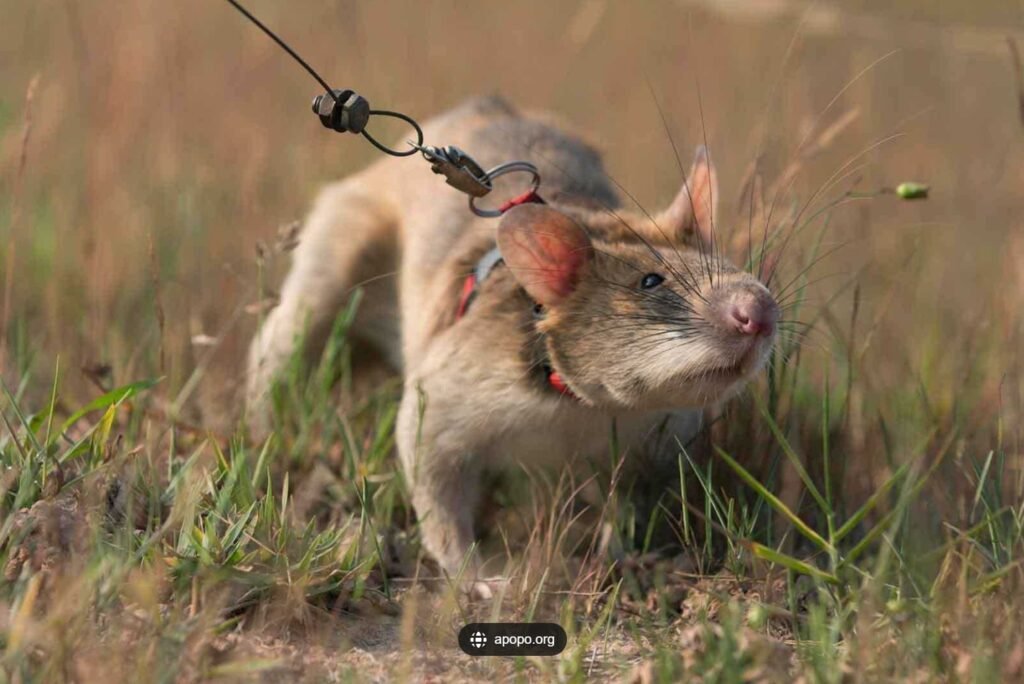
APOPO
A registered Belgian non-government organisation and US non-profit which trains African giant pouched rats and technical survey dogs to detect landmines and tuberculosis. They call their trained animals HeroRATS and HeroDOGS.
Landmine Detection
The rats are trained to sniff out the chemical compounds in explosives, particularly TNT, found in landmines and other unexploded ordnance (UXO).
Speed and Efficiency
A HeroRAT can search an area the size of a tennis court in about 30 minutes, a task that can take a human deminer with a metal.
- detector up to four days, especially in areas with lots of scrap metal (which the rats ignore).
- Safety: The African giant pouched rats are too light (weighing around 1-1.3 kg) to trigger pressure-activated landmines, making their work extremely safe.
- Method: They work on a leash with a handler and, upon detecting the scent of explosives, they signal by scratching the ground. APOPO deploys them in countries across Africa (like Angola and Mozambique) and Asia (like Cambodia).
Tuberculosis (TB) Detection
The rats are also trained to detect the scent of Mycobacterium tuberculosis in human sputum (saliva) samples.
- Speed: In a laboratory setting, a single HeroRAT can screen 100 sputum samples in about 20 minutes, a job that takes a lab technician using a microscope up to four days.
- Impact: By speeding up the diagnostic process, they help clinics identify more positive cases quickly, allowing patients to start treatment sooner and preventing the disease from spreading.
APOPO is also actively training a group of their African giant pouched rats to search for earthquake and disaster victims trapped in rubble. They have even given them the working name “RescueRATs.”
The use of rats for this type of search and rescue leverages their unique physical characteristics and training:
- Size and Agility: Unlike larger search dogs, the rats’ small size and nimbleness allow them to squeeze through tiny cracks, gaps, and ventilation shafts within unstable piles of rubble and debris where humans or dogs cannot safely navigate.
- Scent Detection: The rats are trained to locate the scent of a trapped human. Their training is focused on a complex behavioural sequence:
- Search the debris site for the human scent.
- Once a victim is located, they signal the find.
- They return to the handler upon hearing a recall signal to receive their food reward (usually a tasty mix of avocado and banana).
- Smart Backpacks: The most advanced part of this project involves equipping the rats with miniature, high-tech vests or “backpacks” developed in collaboration with engineers. These tiny packs are designed to include:
A microswitch (often triggered by the rat pulling a ball on the vest) that remotely alerts
- the handler that a victim has been found.
- A video camera and microphone to provide audio and visual feedback from inside the debris.
A speaker for two-way communication, potentially allowing rescuers to speak directly to the trapped victim.